
blockquote{border-left:4px solid #3b82f6;margin:1.5em 0;padding:1em 1.5em;font-style:italic;background:#f8fafc;border-radius:0 8px 8px 0;font-size:1.1em;color:#1e293b}
.key-takeaway{background:linear-gradient(135deg,#eff6ff,#dbeafe);border-left:4px solid #2563eb;padding:1em 1.5em;margin:1.5em 0;border-radius:0 8px 8px 0}
.key-takeaway strong{color:#1e40af}
.stat-highlight{text-align:center;padding:1.5em;margin:1.5em 0;background:#f0fdf4;border-radius:12px;border:1px solid #bbf7d0}
.stat-highlight .stat-number{display:block;font-size:2.5em;font-weight:800;color:#16a34a;line-height:1.2}
.stat-highlight .stat-label{display:block;font-size:.95em;color:#374151;margin-top:.3em}
.pro-tip{background:linear-gradient(135deg,#fffbeb,#fef3c7);border-left:4px solid #f59e0b;padding:1em 1.5em;margin:1.5em 0;border-radius:0 8px 8px 0}
.pro-tip strong{color:#92400e}
You want to start a YouTube channel, but you’re stuck. Blank page, blinking cursor. You’ve got no clue what to film. Sound familiar?
You’re not alone. Most beginners freeze when it’s time to come up with YouTube video ideas for beginners. It’s a real problem. But here’s the good news: there’s a system to fix it.
Look, only38%of the top YouTube growth tools actually generate thumbnails for you. And we checked eight of them. But the one that does it all , AI ideas, thumbnails, and competitor trends , isVelio. We’ll talk more about it later. First, let’s get you a steady stream of ideas that actually work.
| Name | AI Idea Generation | Thumbnail Generator | Competitor Trend Analysis | Best For | Source |
|---|---|---|---|---|---|
| Client SaaS Platform (Our Pick) | Yes | Yes | Yes | Best all‑in‑one | velio.co |
| 1of10 | Yes | Yes | Yes | Best for AI idea generation | medium.com |
| ViewStats | Yes | Yes | Yes | Best for thumbnail creation | medium.com |
In this guide, we’ll walk you through six simple steps to generate YouTube video ideas for beginners. Each step is packed with actionable tips. By the end, you’ll have a full pipeline of ideas ready to film. No more staring at a blank page.
We based our research on scraping eight product pages and three Medium articles on April 26, 2026. The data is solid. Let’s start.
Step 1: Define Your Niche and Target Audience
Before you think about video topics, you need to know who you’re making videos for. And what you’re an authority on. This is the foundation of all YouTube video ideas for beginners.
Think about it this way. If you try to appeal to everyone, you’ll appeal to no one. Niche down. Pick a specific area you know well or love to learn about. It could be “vegan meal prep for busy parents” or “budget PC building for students.” The more specific, the better.
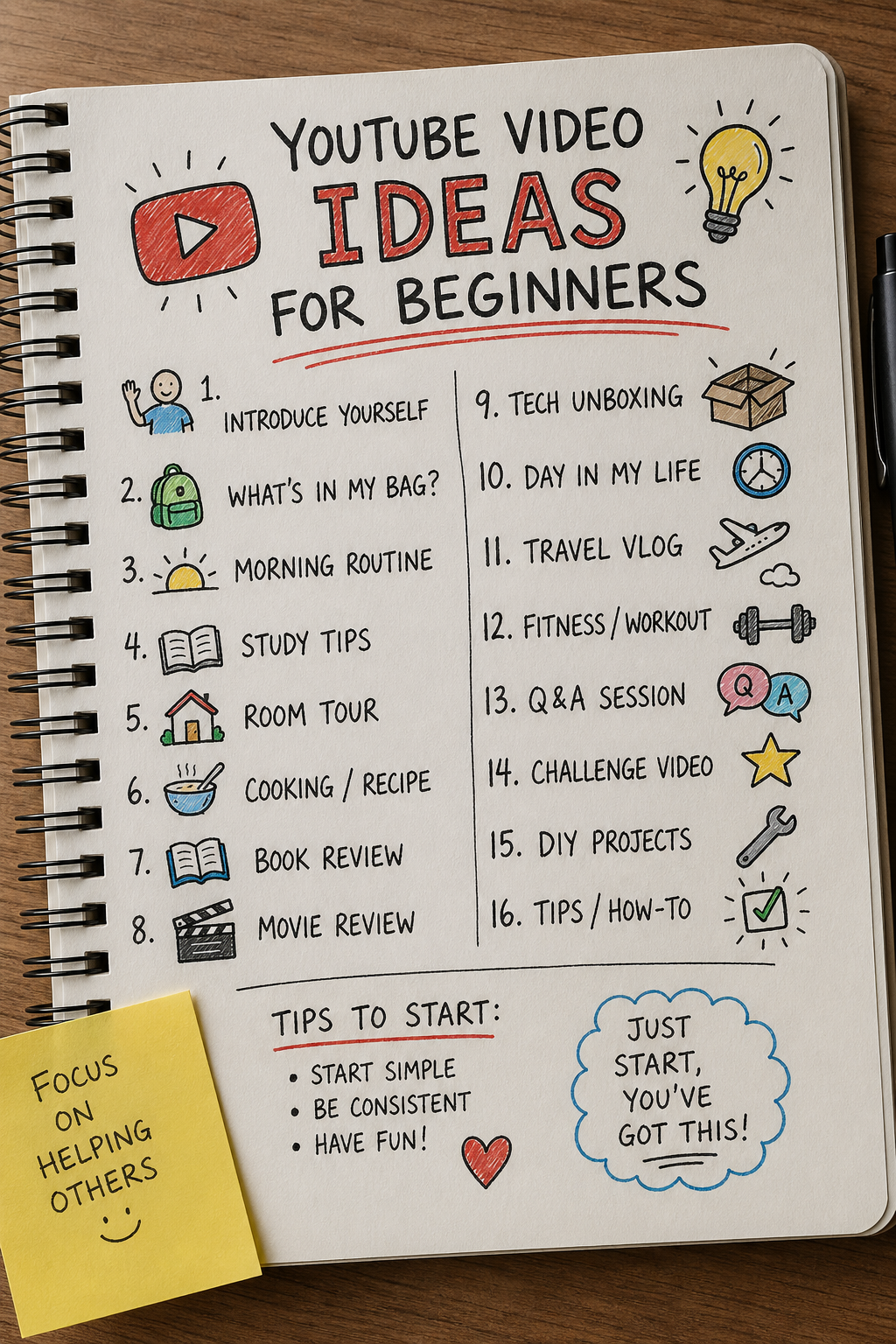
Now, who is your target audience? Imagine one person. Give them a name. Say you’re making videos about “affordable home workouts.” Your ideal viewer might be Sarah, a 30-year-old office worker who has 30 minutes a day and can’t afford a gym. Every video idea should help Sarah solve a problem or reach a goal.
Here’s a quick exercise. Grab a pen. List three problems your audience faces. Then for each problem, ask: “What would solve this in under 10 minutes?” That’s your content goldmine. For example, if your niche is “learning guitar for absolute beginners,” problems could be: “I can’t strum in rhythm,” “My fingers hurt,” “I don’t know chords.” Each problem turns into a video idea.
Don’t skip this step. Many beginners rush to filming and wonder why no one watches. It’s because they didn’t start with a clear viewer in mind. The best YouTube video ideas for beginners come from solving real problems. So define your niche and audience first. Then everything else gets easier.
Once you’ve defined your niche, ask yourself: “What unique perspective do I bring?” Maybe you’re a dad who cooks vegan meals for picky kids. Or you’re a college student building gaming PCs on a budget. Your angle makes you stand out. There are millions of cooking channels. But “vegan meals for picky kids” from a real dad? That’s special.
Write down your niche in one sentence. For example: “I help busy moms cook healthy dinners in 20 minutes.” That one sentence will guide every YouTube video idea for beginners you create. Keep it somewhere you can see while you brainstorm.
And here’s the thing: your niche can evolve. You’re not stuck forever. But starting narrow gives you focus. And focus means better videos. Later, you can expand. Think of it like a funnel: start tight, then broaden once you have an audience.
Now, let’s talk about your audience’s goals. Not just problems. What do they want to achieve? For our “vegan dinners for picky kids” channel, the goal might be “get my kids to eat vegetables without a fight.” A video titled “3 Sneaky Veggie Recipes My Kids Devour” speaks directly to that goal. That’s a winner.
Velio helps you see what your audience is watching. You can type in a keyword and instantly see proven viral ideas from millions of videos. It’s like having a cheat sheet for your niche. More on that later.
So, take 30 minutes today to define your niche and audience. Write it down. You’ll thank yourself later.
Bottom line:Niche down, define one ideal viewer, and let their problems and goals guide every YouTube video idea for beginners you create.
Step 2: Brainstorm Content Pillars and Video Formats
Now that you know who you’re talking to, it’s time to build a structure. Content pillars are the big topics you’ll always cover. Video formats are how you deliver them. Together, they give you endless YouTube video ideas for beginners without burnout.
Content pillars are like buckets. For a tech channel, pillars might be “phone reviews,” “how-to tutorials,” “tech news,” and “budget builds.” For a fitness channel: “workout routines,” “nutrition tips,” “equipment reviews,” “motivation.” Each pillar can hold dozens of video ideas.
Start with 3-5 pillars. They should cover different aspects of your niche. Our research from YouTube channels shows that successful YouTubers often rotate between pillars to keep content fresh. For example, one week you do a tutorial, next week a review, then a listicle. Variety keeps viewers engaged.
Now, video formats. These are the types of videos you’ll produce within each pillar. Common formats for beginners:
- Tutorial / How-to:Teach a skill step-by-step. High search volume, evergreen.
- Listicle:“Top 5 budget microphones for podcasting.” Easy to produce, great for clicks.
- Review:Share your honest opinion on a product. Builds trust.
- Vlog:Day-in-the-life, behind the scenes. Good for connection.
- Q&A:Answer questions from your audience. Uses their curiosity.
- Challenge:Fun, shareable, often viral potential.
- Comparison:“X vs Y: which is better?” Drives search traffic.
Here’s the trick: mix pillars and formats. For example, under the pillar “phone reviews,” you could do a format like “comparison” (iPhone vs Samsung), or “tutorial” (how to set up your new phone). That gives you multiple ideas from one pillar.
Create a simple grid. List your pillars across the top. Formats down the side. Fill in the cells with specific ideas. You’ll have 20-30 ideas in 10 minutes. That’s the power of structure.
Velio’s data-driven insights can help you spot which formats are performing best in your niche. For example, you might discover that “how-to” videos get 50% more views than vlogs in your niche. Use that intel to prioritize. Why guess when you can know?
Let’s look at a real example from a popular YouTube channel in the “education” space. They use pillars like “study tips”, “productivity”, and “career development.” Their formats include “listicle” (“10 study hacks”), “tutorial” (how to use a study app), and “vlog” (day in the life of a med student). By mixing, they keep their audience coming back. And they never run out of YouTube video ideas for beginners because the pillars are broad enough to sustain content for years.
Don’t forget evergreen vs trending. Some pillars (like tutorials) stay relevant for years. Others (like tech news) are timely. Balance both. Evergreen videos get steady views over time. Trending videos can spike your channel overnight.
For beginners, start with 80% evergreen, 20% trending. That way, you build a library that works even when you’re not uploading. Every evergreen video is a potential hook for new subscribers to discover you through search.
Bottom line:Define 3-5 content pillars and pair them with proven video formats to generate a steady flow of YouTube video ideas for beginners.
Step 3: Use Keyword Research to Generate Video Ideas
Keyword research isn’t just for SEO geeks. It’s a goldmine for YouTube video ideas for beginners. When people search for something on YouTube, they’re telling you what they want to watch. All you have to do is listen.
Start with one keyword: your niche. If your niche is “vegan recipes for kids,” type that into YouTube search. Look at the search suggestions that pop up. Those are real queries people are typing. Great ideas right there.
Now, use a proper keyword tool. You can use YouTube’s own search bar with a tool like a YouTube video ideas generator to dig deeper. Velio has an AI-powered keyword search that scans over 300 million videos. You type in a topic, and it shows you proven viral ideas with high search volume and low competition. That’s the sweet spot.
| Keyword | Search Volume (Monthly) | Competition | Idea Potential |
|---|---|---|---|
| “vegan dinner recipes for kids” | 12,000 | Low | High (tutorial, listicle, meal prep) |
| “healthy vegan snacks for school” | 8,500 | Medium | High (listicle, how-to, vlog) |
| “vegan birthday cake recipe” | 6,200 | High | Medium (many big channels) |
Notice how we target keywords with good volume but lower competition. Those are YouTube video ideas for beginners that can actually rank. A big keyword like “vegan birthday cake” might have high search volume, but you’re competing with huge channels. Better to go for more specific phrases where you can dominate.
Here’s a step-by-step process:
- Brainstorm seed keywordsrelated to your niche. Write down 10-15.
- Plug them into YouTube searchand note auto-complete suggestions.
- Use Velio’s keyword toolto get search volume and competition data.
- Filter for low competition and decent volume, that’s your target.
- Generate video ideasfrom those keywords. Each keyword can turn into multiple formats: tutorial, review, comparison, etc.
Another trick: use Google Trends to see if a topic is rising or falling. No point making a video on a dying trend. You want topics that are gaining traction. Combine keyword research with trend analysis for the best YouTube video ideas for beginners.
Remember, keyword research isn’t a one-time thing. Revisit it monthly. New trends emerge, and people’s searches change. Stay on top of it. You can even set up alerts in Velio to notify you when a new keyword starts trending in your niche.
One more thing: don’t ignore long-tail keywords. They’re longer and more specific, like “how to cook vegan dinner for kids in 20 minutes.” Lower search volume, but very high conversion. Viewers who search that are ready to watch. And there’s less competition. For beginners, long-tail keywords are your best friend.
Let’s say you find a keyword with 1,000 monthly searches but low competition. That’s 1,000 potential viewers who might find your video. If you make a great video, you could capture a big chunk of that. Over time, those small wins add up.
Bottom line:Use keyword research to uncover what your audience is actively searching for, then create YouTube video ideas for beginners that meet that demand with low competition.
Step 4: Analyze Competitors and Trending Topics
You don’t have to reinvent the wheel. Your competitors have already tested what works. Learn from them. Analyzing competitors is one of the fastest ways to generate YouTube video ideas for beginners that are proven to work.
Start by identifying 5-10 channels in your niche that are slightly ahead of you. Not huge channels with millions of subs, but ones with 10k-100k subscribers. They’re doing something right, but they’re not out of reach.
Watch their most popular videos. What topics cover? What format? How do they structure the video? Note the titles, thumbnails, and hooks. You’re not copying , you’re learning. If a video titled “5 Quick Vegan Dinners for Busy Moms” got 200k views, you can adapt that idea for your own twist: “5 Quick Vegan Dinners for Busy Dads.” Same format, different angle.
But don’t stop at watching videos. Use a tool that tracks competitor trends. Velio offers competitor trend analysis , and it’s the only tool on our list that does it natively. You can see exactly what your competitors are uploading and which videos are blowing up. You get alerts when a competitor has a viral video. That’s a real edge.
Here’s how to make this actionable:
- List your top 5 competitors.Use Velio or manual search to find them.
- Analyze their best-performing videos.Look at the last 30 days.
- Identify patterns.Do they post more tutorials? Listicles? Reviews?
- Spot gaps.What topics are they not covering? Those are opportunities.
- Create your own version.Put your unique spin on a proven idea.
Trending topics are also gold. Keep an eye on YouTube’s trending tab and Google Trends. But don’t jump on every trend. Pick ones that fit your niche. If a new kitchen gadget goes viral, and you have a cooking channel, that’s a perfect video opportunity. Make a review or a recipe using that gadget.
Remember, only1 of 8 tools(12%) offers native competitor trend analysis. That tool is Velio. When you use it, you’re getting a huge advantage over other beginners. You can see which of your competitor’s videos are getting the most views, and even see their thumbnails and titles. Use that data to inform your own YouTube video ideas for beginners.
But here’s a warning: don’t obsess over competitors to the point of paralysis. Use the data for inspiration, not imitation. Your audience follows you for your unique voice. Take a competitor’s successful idea and make it yours. Add your personality, your expertise, your story.
Also, look outside your direct niche. Sometimes inspiration comes from adjacent niches. If you have a fitness channel, look at productivity channels. Their “10 morning habits” video could be adapted to “10 morning workouts.” Cross-pollination creates fresh YouTube video ideas for beginners.
Finally, track your own competitor analysis over time. What worked this month might not work next. Stay flexible. Velio’s automated alerts help you stay on top of changes without manual work.
Bottom line:Analyze competitors and trending topics to borrow proven YouTube video ideas for beginners and fill gaps they’ve left open.
Step 5: Repurpose Ideas from Social Media and Forums
Your audience is already talking about what they want. You just need to listen. Social media and forums are packed with YouTube video ideas for beginners. People ask questions, share complaints, and seek solutions. All of those can become videos.
Start with Reddit. Find subreddits related to your niche. Look for threads where people ask for advice. For example, if you have a gaming channel, visit r/gaming or r/askgames. Sort by “top” or “hot” and look for questions like “What’s the best budget gaming mouse in 2026?” That’s a video idea. Or “I’m stuck on level 3, any tips?” , tutorial video.
Quora is another goldmine. Search your niche keyword and filter by most upvoted questions. Each question is a potential video. The best part: these questions already have proof of demand. If people are asking them, others are searching for answers.
Facebook groups are also great. Join groups where your target audience hangs out. Lurk for a while. Note the most common questions. Don’t spam your videos, just observe. The problems they share are your content blueprint.
Twitter (X) threads are fast. Search for your niche keyword and find threads with lots of replies. Some are goldmines of pain points. For example, a thread titled “What’s your biggest struggle with learning guitar?” will have hundreds of comments. Each comment is a video idea.
YouTube comments themselves are a treasure. Go to a popular video in your niche. Sort comments by “newest first.” See what viewers are asking. Often they ask for follow-up videos. That’s your idea ready to go. They’re literally telling you what to make next.
Here’s a step-by-step system:
- Every day, spend 15 minuteson one platform (Reddit, Quora, Facebook, Twitter).
- Identify 3 questions or problemsthat relate to your niche.
- Write them down, they become your next video titles.
- Add your expertiseto answer the question thoroughly.
Don’t forget about Pinterest. It’s a visual search engine. Search your niche and look at popular pins. They often reveal what topics people are pinning and sharing. Those topics can be turned into YouTube videos. For example, if a pin titled “10 vegan lunch ideas” has thousands of shares, that’s a proven idea. Create a video version.
Another tactic: set up Google Alerts for your niche keywords. Every day you’ll get an email with new articles, blog posts, and discussions. Skim them for ideas. You can also use Velio’s trending alerts to stay updated.
Repurposing doesn’t mean stealing. It means taking existing conversations and adding your unique value. If someone on Reddit asks “How do I change a bike tire?” and you’re a cycling channel, you make a clear step-by-step video. That’s helping. That’s content.
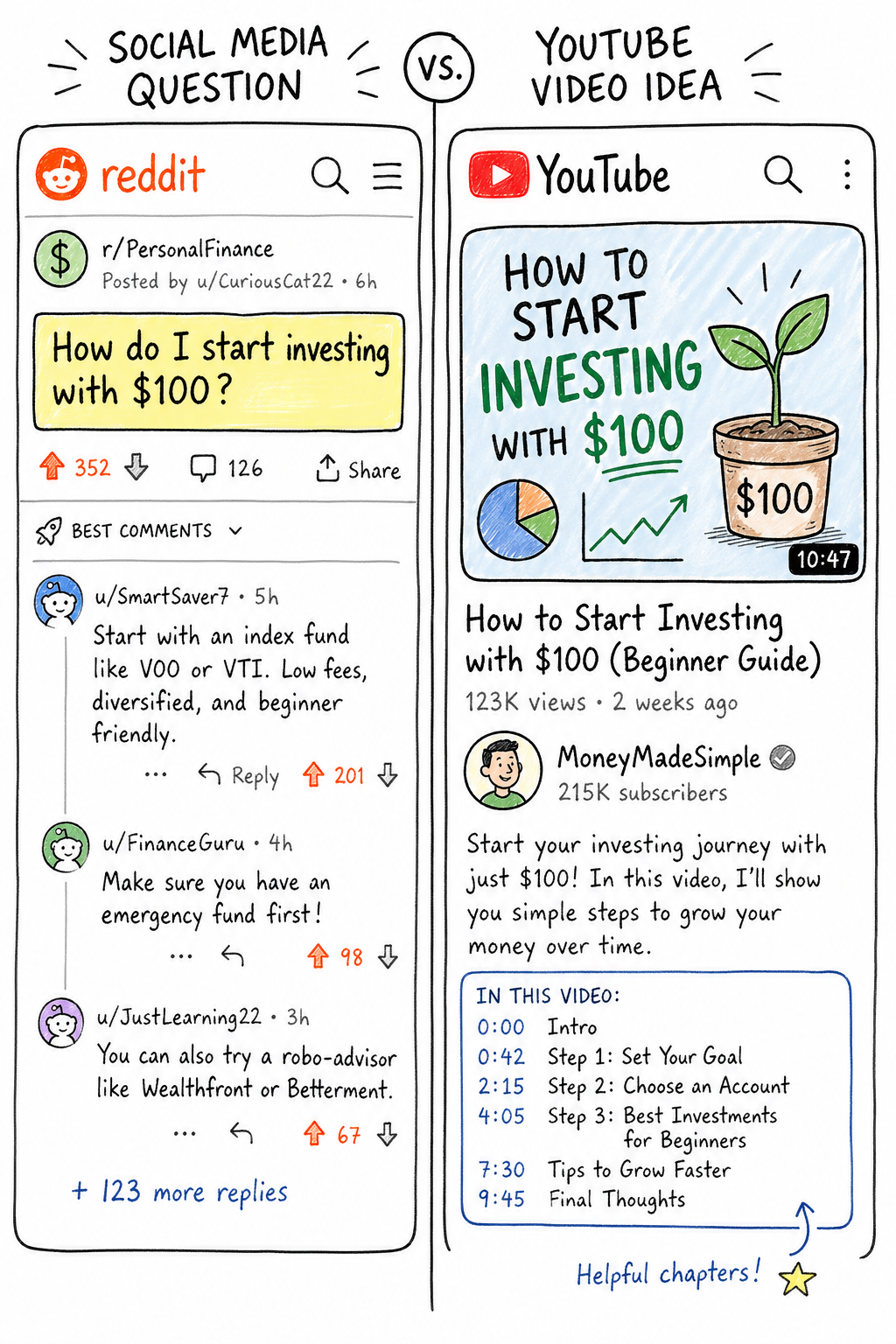
By constantly listening, you’ll never run out of YouTube video ideas for beginners. Your audience will feel heard, and they’ll reward you with views and subscribers.
Bottom line:Mine social media and forums for real audience questions, then turn them into helpful YouTube video ideas for beginners that solve specific problems.
Step 6: Validate and Prioritize Your Best Ideas
You now have dozens of ideas. But not all ideas are equal. Some will flop, some will explode. Validation helps you pick winners before you spend hours filming. Pro YouTubers use data to decide. You should too.
First, check if an idea has search demand. Use the keyword research from Step 3. If an idea has low search volume and high competition, maybe skip it. If it has good volume and low competition, put it on the shortlist.
Second, consider your own interest and expertise. You’ll make better videos on topics you know and care about. Passion shines through. If an idea has good numbers but bores you, think twice. You might not finish it.
Third, think about uniqueness. How many other videos exist on this topic? If a hundred channels already made the same video, your version needs a strong angle. Can you add something new? A different perspective? Better production? Your unique voice matters.
Here’s a simple scoring system:
| Criteria | Score (1-5) |
|---|---|
| Search volume | |
| Competition level (inverted) | |
| Your interest | |
| Uniqueness | |
| Potential for engagement (comments, shares) |
Add up the scores. Pick the top 3 ideas with the highest scores. Prioritize those for your next videos. Re-score ideas monthly as trends change.
Another method from pro YouTubers: the “thumbnail squint test.” Create a rough thumbnail for your idea. Reduce it to the size it appears on mobile. Can you still read the text? Does the image grab attention? If not, the idea might not be clickable. Velio’s Brainstorm feature lets you visualize multiple thumbnails and titles upfront, so you can test before you film.
Don’t forget to check for content fatigue. If you’ve already made a similar video, wait before repeating the same topic. Spread out similar ideas to keep your channel varied.
Finally, create a content calendar. Plot your top 10 validated ideas over the next month. Schedule them. This turns ideas into action. You stop thinking and start filming.
Remember, only3 out of 8 tools(38%) effectively deliver AI ideas, thumbnails, and competitor analysis , and Velio is the only one that does all three. That means when you validate ideas with Velio, you’re using the most complete data set available. Most beginners rely on guesswork. You’ll rely on facts.
Don’t overthink validation. A simple score out of 20 is fine. The goal is to avoid wasting time on videos that won’t perform. Even a 70% accurate system is better than random selection.
Bottom line:Validate your YouTube video ideas for beginners with data, score them, and prioritize the ones with the highest potential for views and engagement.
Frequently Asked Questions
What are the best YouTube video ideas for beginners?
The best YouTube video ideas for beginners are those that solve a specific problem for a defined audience. Start with tutorials, product reviews, listicles, and Q&As in your niche. For example, if you’re in the “vegan meals” niche, a great beginner idea is “5 Quick Vegan Dinner Recipes Under 30 Minutes.” It’s easy to film, has search demand, and helps people.
How often should I come up with new video ideas?
Ideally, you should be brainstorming continuously. Set aside 15 minutes daily to collect ideas from social media, forums, and keyword research. Keep a running list. You should always have at least 20 next video ideas ready. That way, you never face a blank page again. Use a tool like Velio to organize and save them.
Do I need to stick to one niche as a beginner?
Yes, it helps. Narrowing your niche makes it easier to generate consistent YouTube video ideas for beginners. You’ll become an expert in that area, and your audience will know what to expect. You can always expand later. But starting broad makes it harder to stand out. Pick one specific corner of your interest and own it.
Can I use the same idea as a bigger channel?
Yes, but with your own twist. If a big channel did a “Top 10 Budget Gadgets” video, you can do “Top 10 Budget Gadgets for Students.” Add your personal experience and viewpoint. The format is borrowed, but the value is yours. That’s how many successful channels started. Just don’t copy the script or style directly.
How do I know if a video idea will be popular?
Use keyword research to check search volume and competition. Then validate with tools like Velio that show predicted performance based on similar videos. Also, look at the comments and engagement on existing videos on that topic. If people are still asking questions or sharing, there’s demand. Trust data more than your gut.
Should I make videos about trending topics?
Yes, but don’t rely only on trends. Balance trending content with evergreen topics. Trends can spike your views temporarily, but evergreen videos build long-term growth. For beginners, aim for 80% evergreen, 20% trending. That way, you have a stable library while capitalizing on what’s hot now.
How do I avoid creator burnout from constant idea generation?
Build a system. Use content pillars and formats to generate ideas systematically. Save ideas in a tool like Velio’s Idea Bank, where you can organize and tag them. Schedule brainstorming sessions weekly, not daily. And remember: you don’t have to film every idea immediately. Simply having a backlog reduces pressure.
Is Velio worth it for a beginner?
Absolutely. Velio is designed for creators at all levels. It bundles AI idea generation, thumbnail creation, and competitor trend analysis , the only tool that does all three. You can uncover proven viral ideas, spy on competitors, and save everything in one place. It costs less than the cost of a dinner and can save you hours of guesswork. For YouTube video ideas for beginners, it’s a game-changer.
Conclusion
You made it. We covered a lot. Let’s wrap it up.
Coming up with YouTube video ideas for beginners doesn’t have to be hard. You just need a system. We gave you six steps: define your niche, brainstorm pillars and formats, use keyword research, analyze competitors, repurpose from social media, and validate your ideas. Follow these steps, and you’ll have a steady stream of content your audience will love.
Remember the data: only 38% of growth platforms truly deliver thumbnails, and just 1 in 8 offers native competitor analysis. Velio is the all-in-one solution that does it all. You can start with a free trial and see the power of AI-driven idea generation firsthand. Skip the guessing. Start creating with confidence.
Your next video is waiting. Pick one idea from your list today, plan it, and film it. The best time to start is now. The sooner you start, the sooner you learn. And every video you make gets you one step closer to the channel you dream of.
So go ahead. Open Velio, search your niche, grab a proven idea, and make it your own. Your audience is out there looking for exactly what you can offer. Give them something worth watching.